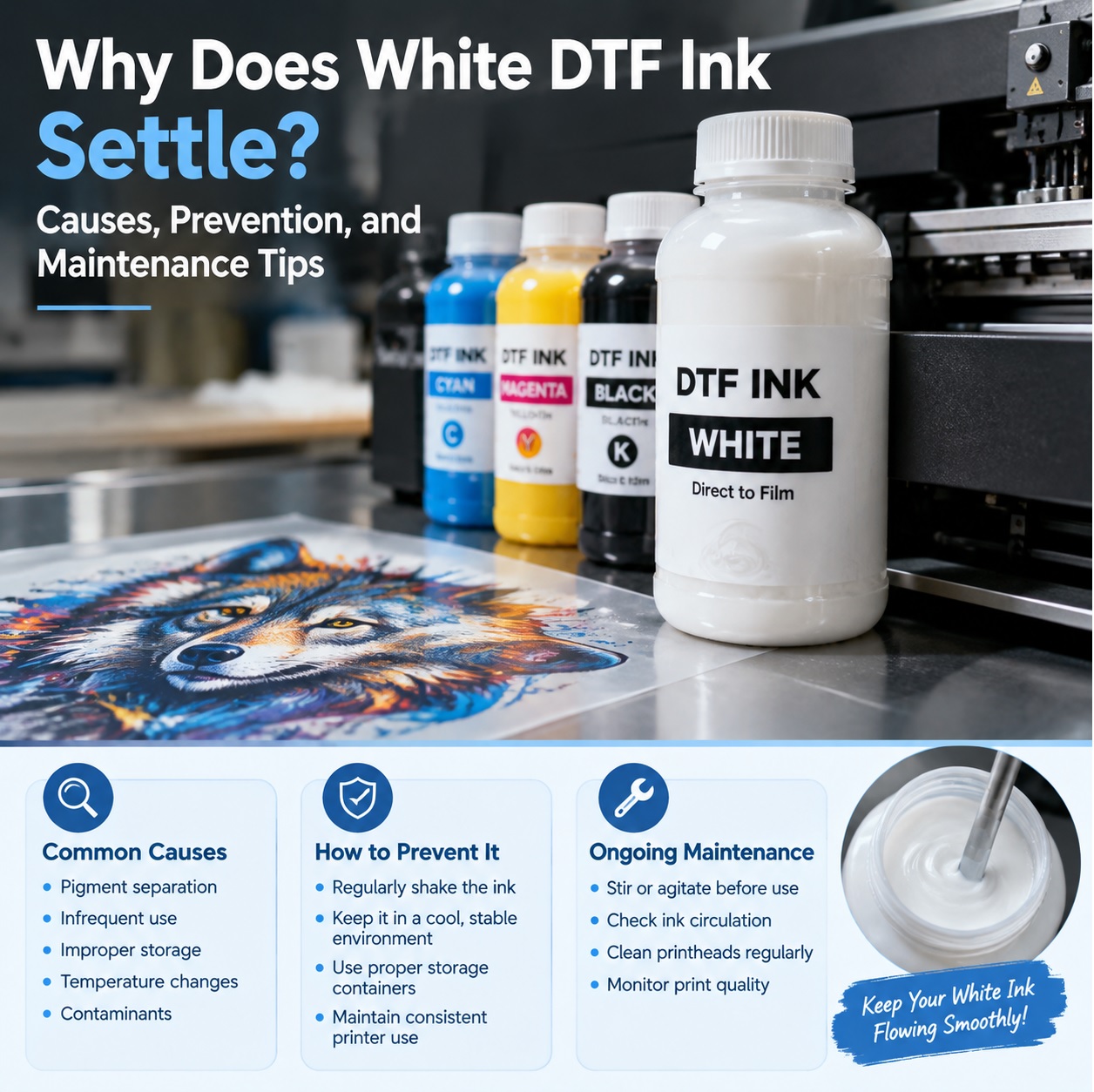
White DTF ink doesn’t separate out of spite. It does it because physics says so, and physics doesn’t care how much you paid for that bottle.
If you’ve ever opened a white ink channel after a quiet weekend and found something resembling watery milk on top and thick chalky sludge at the bottom, you’re not doing anything wrong. You’re just running into the single most predictable behavior of pigment-based ink. The question isn’t whether white ink will settle. It’s how fast, how badly, and whether you catch it before it ruins a print or, worse, clogs a head.
Let’s talk about what’s actually happening in that cartridge, because once you understand the mechanics, the maintenance routine stops feeling like superstition and starts feeling like common sense.
The reason white is the problem child comes down to pigment load. Cyan, magenta, yellow, and black can get away with relatively light pigment concentrations and still look saturated, because color absorbs light and your eye fills in the rest. White doesn’t have that luxury. To be opaque, white ink needs titanium dioxide, and it needs a lot of it. Titanium dioxide is dense. It’s heavy. It’s essentially finely ground mineral powder suspended in a liquid carrier, and heavy particles in a light liquid will sink. That’s not a defect. That’s gravity doing its job.
Add heat to the equation and settling accelerates. Warm storage, a hot print room, a machine sitting in direct sun near a window, all of it thins the carrier liquid and lets those particles drop faster. Cold is a different problem. Let ink get too cold and the resin components can thicken or partially gel, which makes redispersion harder even after things warm back up.
Time is the other silent factor. Every hour a printhead sits idle, particles drift downward. Overnight is usually fine if your printer runs a circulation cycle. A long holiday weekend with the machine off and no agitation is where people get into trouble. So is old stock. Ink has a shelf life, and a bottle that’s been sitting in a warehouse for a year is already partway to separation before you ever shake it.
Then there’s the human factor. Skipping the shake. Running a white-heavy job after the printer’s been idle for three days without a single purge. Topping off a half-empty cartridge with fresh ink and assuming the mix will sort itself out. These small shortcuts are how a settling problem turns into a clogged damper, a starved nozzle, or a white layer that prints thin and patchy on one side of the film.
So what do you actually do about it?
Shake. Then shake again. White ink needs genuine agitation, not a polite little wobble. Bottles should be shaken for a solid minute before pouring, and if you’re using a bulk system, your circulation pump is doing that work for you and it needs to be running on a schedule. If your printer supports white ink recirculation, use it. This is not a feature to save for special occasions.
Store ink like you mean it. Room temperature, roughly 18 to 25 degrees Celsius, out of sunlight, caps tight, bottles upright. Don’t stockpile more white ink than you’ll use in a few months. Buying in bulk to save a few dollars per liter is a losing trade if half of it separates past the point of recovery before you get to it.
Keep the machine moving. A DTF printer that runs daily is a happy DTF printer. If your production schedule is lumpy, build in a daily maintenance print or at minimum a short purge cycle so the white channel never sits completely still. Idle time is settling time.
Watch your environment. Humidity matters more than most people realize. Very dry air encourages ink to dry at the nozzle plate and in the capping station, and dried white ink is stubborn. A basic hygrometer and a small humidifier cost less than a printhead.
Then there’s the routine most shops neglect until something breaks. Clean the capping station and wiper blade on a schedule, not when you notice a problem. Check that the cap is sealing properly, because a poor seal lets ink dry and pull air. Run a nozzle check every morning and actually look at it instead of glancing and moving on. If the white channel shows dropouts, do a targeted cleaning immediately rather than pushing through a big order and hoping it clears itself.
If you’re already seeing separation in the lines, don’t panic and don’t just run a heavy clean. First, agitate the ink supply. Then do a modest purge. Then print a small test. Escalating straight to aggressive cleaning cycles wastes ink, stresses the head, and often doesn’t fix the underlying issue, which is that the pigment needs to be back in suspension, not that the nozzle is dirty.
And if you’re shopping for ink or a printer right now, this is the part worth paying attention to. Not all white DTF inks settle at the same rate. Formulation matters enormously. The quality of the pigment dispersion, the particle size distribution, the resin system, and the stabilizers all determine how long that bottle can sit before it turns into a two-layer mess. Cheap ink with coarse dispersion and weak stabilization will settle in days. Well-formulated ink with properly milled pigment and good dispersants can hold for weeks with normal agitation.
That’s the difference you’re actually paying for when you buy from a serious supplier. It’s not the label or the bottle. It’s how much babysitting the ink demands from you, and how much of your production week gets eaten by maintenance you shouldn’t have to do.
White DTF ink will always settle to some degree. That’s the nature of the chemistry. But the gap between an ink that needs a daily shake and one that fights you every single morning is enormous, and it shows up in your uptime, your waste, and your print quality. Understand the cause, build the habits, and choose your ink like it’s part of your equipment rather than a consumable you grab because it was cheapest. Your printhead will thank you, and so will your production schedule.