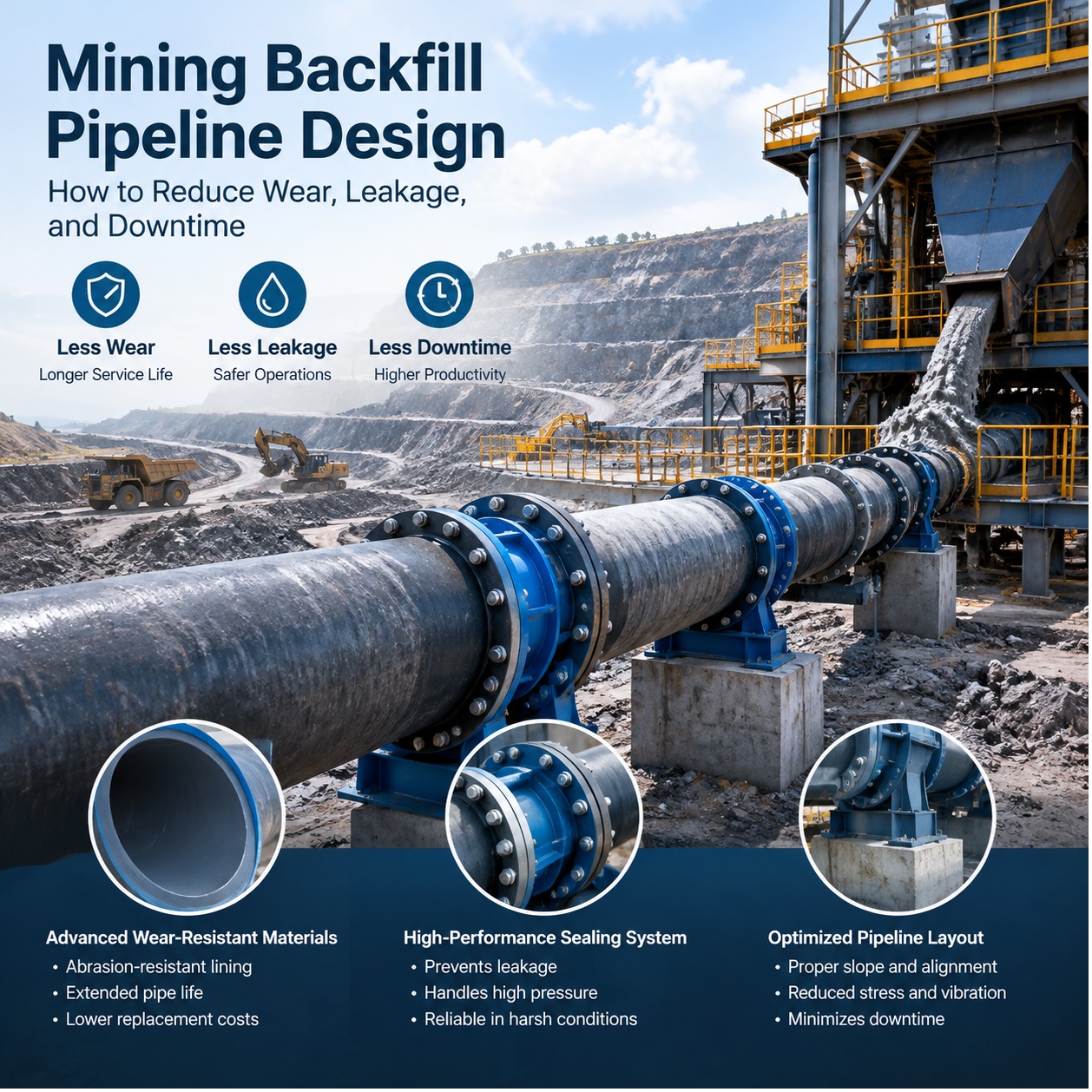
 A mining backfill line rarely fails politely. It gives you a soft warning first: a damp patch under a bend, a flange that needs another turn every few weeks, a pump pressure curve that drifts a little more each shift. Then one day the elbow wears through, a gasket lets go, or the line plugs solid, and the entire stope sequence stalls while everyone stands around asking how a pipe became the bottleneck.
Most operations do not have a backfill problem. They have a design problem that shows up as maintenance. Wear, leakage, and downtime are not separate curses. They are symptoms of how the pipeline was sized, routed, supported, joined, and monitored. Fix the design, and you stop paying the same tax every month.
Wear Is a Design Decision
Backfill slurry is not water. It is a moving abrasive tool. Every particle that hits a pipe wall takes a small cut. The question is not whether wear will happen. The question is where, how fast, and whether you can predict it.
Velocity is the first lever. Too slow, and solids settle, raising the risk of blockages and uneven wear. Too fast, and you sandblast your own pipeline from the inside. The sweet spot depends on your particle size distribution, binder chemistry, density, and flow rate. Guess it, and you will replace bends on a calendar. Model it, and you can plan replacements around production, not panic.
Bend geometry matters just as much. A tight radius forces the slurry to change direction hard. The outer wall takes the hit. Long-radius bends, properly supported, spread the impact and add service life. Material choice is next. Mild steel has its place, but high-wear zones often justify ceramic liners, hardened alloys, or composite pipe. The trick is not lining everything. It is lining the right sections and rotating or replacing them before they fail.
Leakage Starts at the Joints
A leak is rarely just a bad gasket. It is usually a system telling you it is misaligned, over-pressured, under-supported, or vibrating itself apart. Flanges that are not flat, bolts that are not torqued in sequence, expansion joints that are asked to absorb movement they were never sized for, and pipe supports spaced for convenience instead of load. These are design and installation issues, not bad luck.
Pressure surges are silent leak makers. A valve closes too fast, a pump stops suddenly, and a shock wave travels through the line. The pipe may survive. The joints may not. Proper surge analysis, slow-closing valves, accumulators, and restrained joints can turn a violent event into a manageable one.
Thermal movement and ground settlement also matter. A pipeline that is rigid where it should be flexible will crack. A pipeline that is flexible where it should be anchored will move until something gives. Good design defines the movement, then gives it a safe place to happen.
Downtime Is a Schedule You Build In
Downtime does not start when the line stops. It starts when a repair requires a crane, scaffolding, confined space entry, and a spare part that is sitting in a warehouse three time zones away. If changing a worn spool takes two shifts, the design already failed.
Design for maintenance access. Add isolation valves so you can lock out a section without draining the whole circuit. Use modular spools and standardized flanges so replacements fit without field fabrication. Leave room for a manlift or a small crane. Label the wear zones. Keep a critical spares list that matches the actual failure history, not a generic parts catalog.
Monitoring turns maintenance from reactive to planned. Pressure and flow sensors reveal changes in hydraulic behavior. Acoustic sensors can hear a leak before it becomes a spill. Wear coupons, ultrasonic thickness testing, and regular non-destructive inspections show you exactly how much steel or liner is left. When you know the wear rate, you can schedule a replacement during a planned shutdown instead of gambling on a Friday night.
The Hidden Cost of Cheap Design
The cheapest pipe per meter is rarely the cheapest pipeline per year. A low-bid design often saves money on wall thickness, bend radius, support spacing, and instrumentation. Then it spends that savings several times over on emergency labor, lost production, cleanup, and safety incidents.
Total cost of ownership tells the real story. Add up the cost of a single unplanned backfill outage: idle miners, delayed stope preparation, rented equipment, overtime, and the downstream scheduling chaos. Now compare that to the cost of a proper hydraulic study, a few long-radius bends, a handful of pressure sensors, and a spares strategy. The math is not close.
What Good Design Looks Like
A reliable backfill pipeline is not a collection of premium parts. It is a system. It starts with accurate slurry data and a hydraulic model. It continues with a route that avoids unnecessary bends and gives maintenance crews room to work. It uses materials and liners matched to the actual wear profile. It includes joints, supports, and surge protection sized for real operating conditions. It finishes with monitoring, commissioning, and a maintenance plan that tells you what to watch and when to act.
That is not overengineering. That is respecting the fact that backfill is the backbone of your mining cycle. When the line runs, the mine runs. When the line fails, everything upstream and downstream feels it.
If you are planning a new backfill circuit or patching one that eats elbows and leaks at every flange, bring your slurry data, your layout constraints, and your downtime history. The right design partner will show you where the wear is coming from, where the leaks are hiding, and how much production you are losing to a pipeline that was never set up to last.